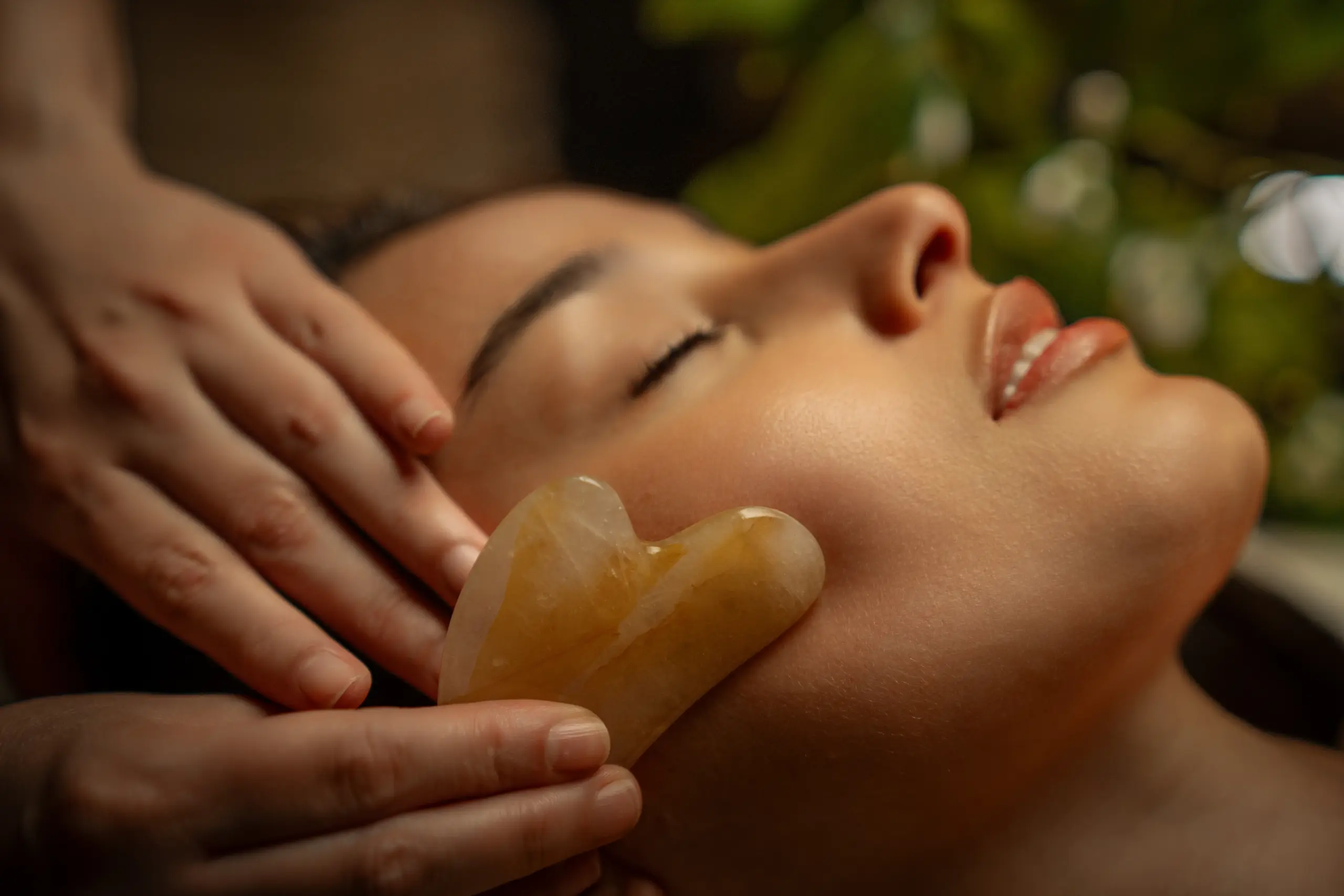


If you have come across gua sha on a skincare shelf or in a self-care routine and wondered what it actually is and what it does, this guide covers it clearly. Gua sha is a technique that more and more people are adding to their daily ritual, not as a treatment, but as a simple, calming way to care for the skin on the face. This article explains what it is, what people use it for, how to do a basic facial routine safely, how it compares to a jade roller, and when it is better to check with a doctor before trying it.
What is gua sha?
Gua sha is a traditional East Asian technique that involves using a smooth-edged tool to stroke the skin with light, controlled pressure. The name comes from Chinese: «gua» means to scrape or stroke, and «sha» refers to the redness that appears on the skin during the original practice. In traditional Chinese medicine, it was applied to the body, often the back and neck, to address tension and promote circulation.
Facial gua sha is a gentler, more modern adaptation of that tradition. Rather than the firm pressure used on the body, the facial version uses light strokes on the face and neck. It has become a popular self-care ritual, valued more for its calming quality and the feeling it gives the skin than for any medical claim.
Gua sha tools are made from a range of materials: jade, rose quartz and stainless steel are among the most common. The material affects the feel and temperature of the tool, but there is no scientific evidence that one material performs better than another for skin. What matters most is the shape, the edge quality and how you use it.
Gua sha benefits: what people use it for
The gua sha benefits people most commonly seek are relaxation, a feeling of reduced puffiness in the morning, and the ritual quality of the practice itself. Many people describe it as a calming part of their skincare routine, a few minutes of intentional, slow movement that makes them more aware of how their face and neck feel.
It is worth being clear about the evidence. Scientific study of facial gua sha is limited, and many of the effects people notice, such as a temporary sense of freshness or reduced tension in the jaw and temples, have not been confirmed in controlled clinical trials. Claims around lifting the face, draining the lymphatic system or removing toxins from the skin are not supported by robust evidence and should not be taken as guaranteed outcomes.
What the research does suggest, cautiously, is that gua sha may support circulation in the treated area and that the light massage involved can temporarily ease muscle tension. Effects are temporary. This is not a medical treatment and it does not replace professional skincare or aesthetic procedures. If you are looking for clinical results, speak to a dermatologist.
How to use gua sha: a simple facial routine
The key to a safe facial gua sha routine is light pressure, clean skin, and a well-prepared tool. Here is a simple sequence to follow.
Step 1: Cleanse your face and your tool. Start with a clean face and make sure the gua sha tool has been washed with warm water and dried. Using it on unwashed skin can transfer bacteria.
Step 2: Apply a facial oil or serum. Gua sha should always be used on a well-lubricated surface. A few drops of facial oil or serum allow the tool to glide without dragging or irritating the skin. Never use gua sha on dry skin.
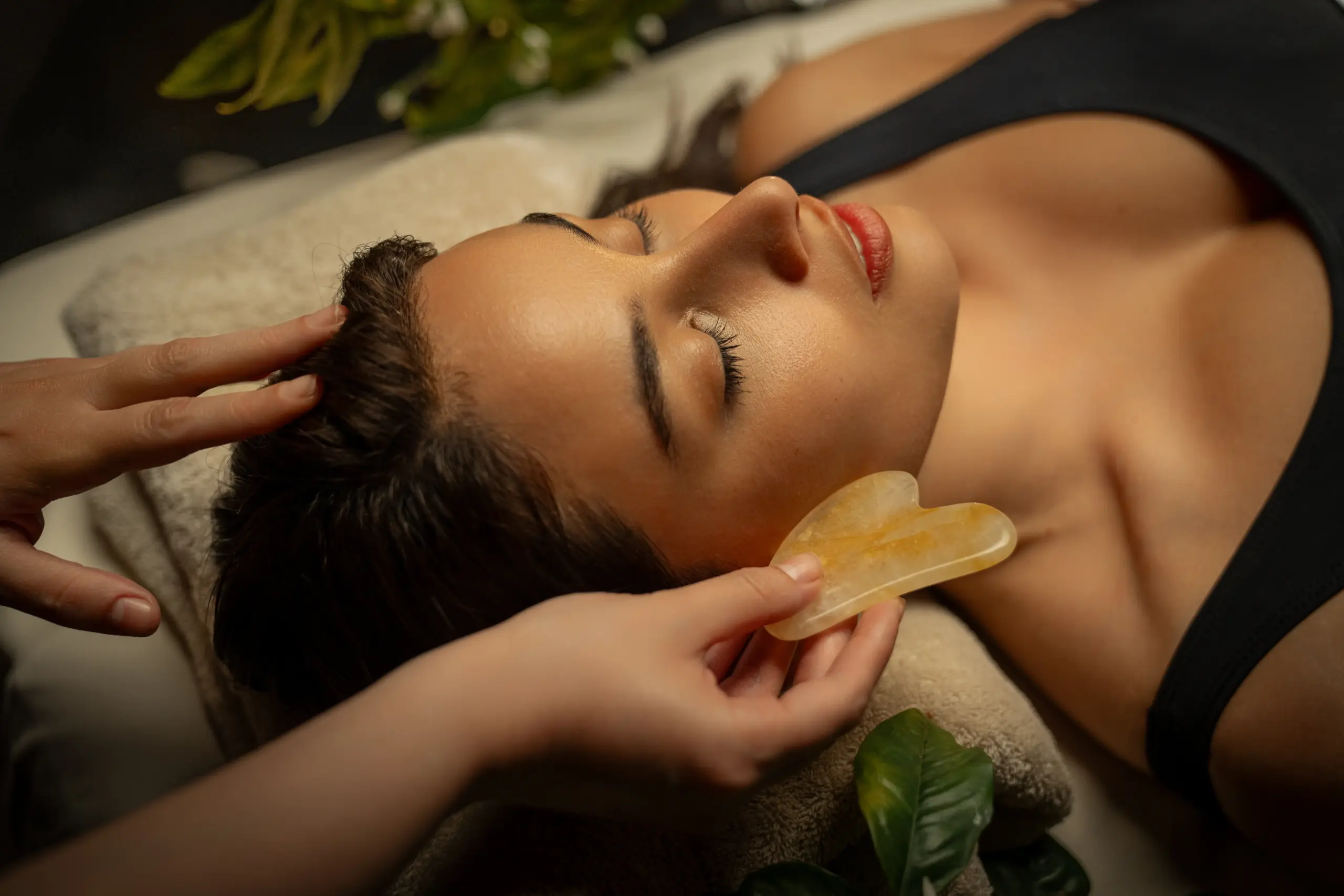
Step 3: Begin at the neck. Use the flat or curved edge of the tool and work upward with long, gentle strokes. Use only light pressure and keep the tool at a shallow angle against the skin.
Step 4: Move to the jawline. Stroke from the chin outward toward the ear on each side. Repeat a few times on each side, keeping the pressure consistent and gentle.
Step 5: Work across the cheeks. Stroke outward from the nose toward the hairline. Avoid pressing hard over bony areas.
Step 6: The eye area. Use the smallest, most curved edge of the tool and work very gently from the inner corner outward, under the eye and above the brow. The skin here is thin: use minimal pressure.
Step 7: The forehead. Stroke upward from the brow toward the hairline, then outward from the centre.
The whole routine takes a few minutes. Finish by cleaning the tool with warm water. Some people use gua sha two to three times a week, though there is no fixed frequency that applies to everyone. If your skin feels irritated or you notice persistent redness, reduce how often you use it or stop and consult a dermatologist.
Gua sha vs jade roller
Both gua sha and jade rollers are used in facial self-care routines, but they work differently and suit different preferences. Here is a clear comparison.
Gua sha is a flat or curved smooth-edged tool used with long, controlled strokes and light pressure. It sits at a shallow angle against the skin and gives more direct, deliberate contact. It works well on the neck, jawline and cheeks, and allows you to adjust pressure precisely as you go.
A jade roller has one or two stone heads on a handle and moves across the skin with a rolling motion. The pressure is lighter and more consistent, with less technique required. It covers larger areas quickly and the cool stone may temporarily soothe the skin, particularly when kept in the fridge.
The jade roller benefits most people describe are the cooling sensation from the stone, the gentle massage effect and the ease of use. It requires less technique than gua sha and is a good starting point if you are new to facial tools. Jade roller benefits tend to be subtle: a temporary feeling of freshness or reduced puffiness, particularly when the roller is kept cold.
Are cold showers good for you? Benefits, risks and when to take one
For how to use a jade roller: apply facial oil or serum first, then roll outward and upward from the centre of the face, using light pressure. Store it in the fridge if you want a cooling effect.
Neither tool is objectively better. It comes down to personal preference, the sensation you enjoy and how much time you want to spend on the routine.
Who should avoid gua sha
Gua sha is not suitable for everyone. Before trying it, check with a doctor or dermatologist if any of the following apply to you.
You are pregnant. You have diabetes or any condition that affects circulation or healing. You are taking blood-thinning medication. You have active acne, open wounds, sunburn or broken skin on the face. You have rosacea or psoriasis. You have had botulinum toxin injections or dermal fillers recently, as the pressure of gua sha may affect the results. You have recently had any cosmetic or aesthetic procedure on the face.
Even in people without any of these conditions, using too much pressure or too much frequency can cause temporary redness or surface irritation. Start gently, observe how your skin responds, and reduce or stop if anything feels wrong. When in doubt, a qualified dermatologist or aesthetician can advise you on whether and how to use facial tools safely.
A facial ritual at AIRE
If you are curious about gua sha but would rather experience it with a professional first, the Orange Garden experience at AIRE Ancient Baths includes a gua sha face massage as part of its ritual. The experience combines thermal baths with a body massage, a cooling hydrogel mask, a scalp massage and the gua sha facial, carried out in a calm, unhurried environment.
It is a way to understand the technique from the inside, with guidance, before deciding whether to build it into your own daily routine.
You can find out which AIRE locations offer the Orange Garden experience and explore the full details at beaire.com.
Frequently asked questions about gua sha
What is gua sha and what is it used for?
Gua sha is a traditional East Asian technique that uses a smooth-edged tool to stroke the skin with light pressure. In its facial form, people use it as a self-care ritual, most commonly for relaxation, a temporary feeling of reduced puffiness and a greater sense of awareness of the face and neck. It is not a medical treatment.
How do you use gua sha on your face?
Always start with clean skin and a clean tool. Apply a facial oil or serum so the tool glides without dragging. Use light pressure and work from the neck upward and outward: jawline, cheeks, eye area and forehead. The routine takes a few minutes. Clean the tool afterwards and avoid pressing hard over sensitive areas.
What is the difference between gua sha and a jade roller?
Gua sha is a flat or curved smooth tool used with controlled strokes and light pressure, giving more direct contact with the skin. A jade roller uses a rolling motion and tends to be gentler and easier for beginners. Both are used on a lubricated face; neither has been shown to deliver significant clinical results, but many people find them a calming addition to their skincare routine.
How often can you use gua sha?
Some people use it two to three times a week. There is no single frequency that works for everyone. Start less frequently, observe how your skin responds, and adjust. If you notice persistent redness or irritation, reduce use and consult a dermatologist.
Who should not use gua sha?
People who are pregnant, have diabetes, take blood thinners, have active acne or open skin, have rosacea or psoriasis, or have had recent injectables or aesthetic procedures should check with a doctor before using gua sha. When in doubt, a qualified professional can advise on whether it is suitable for you.