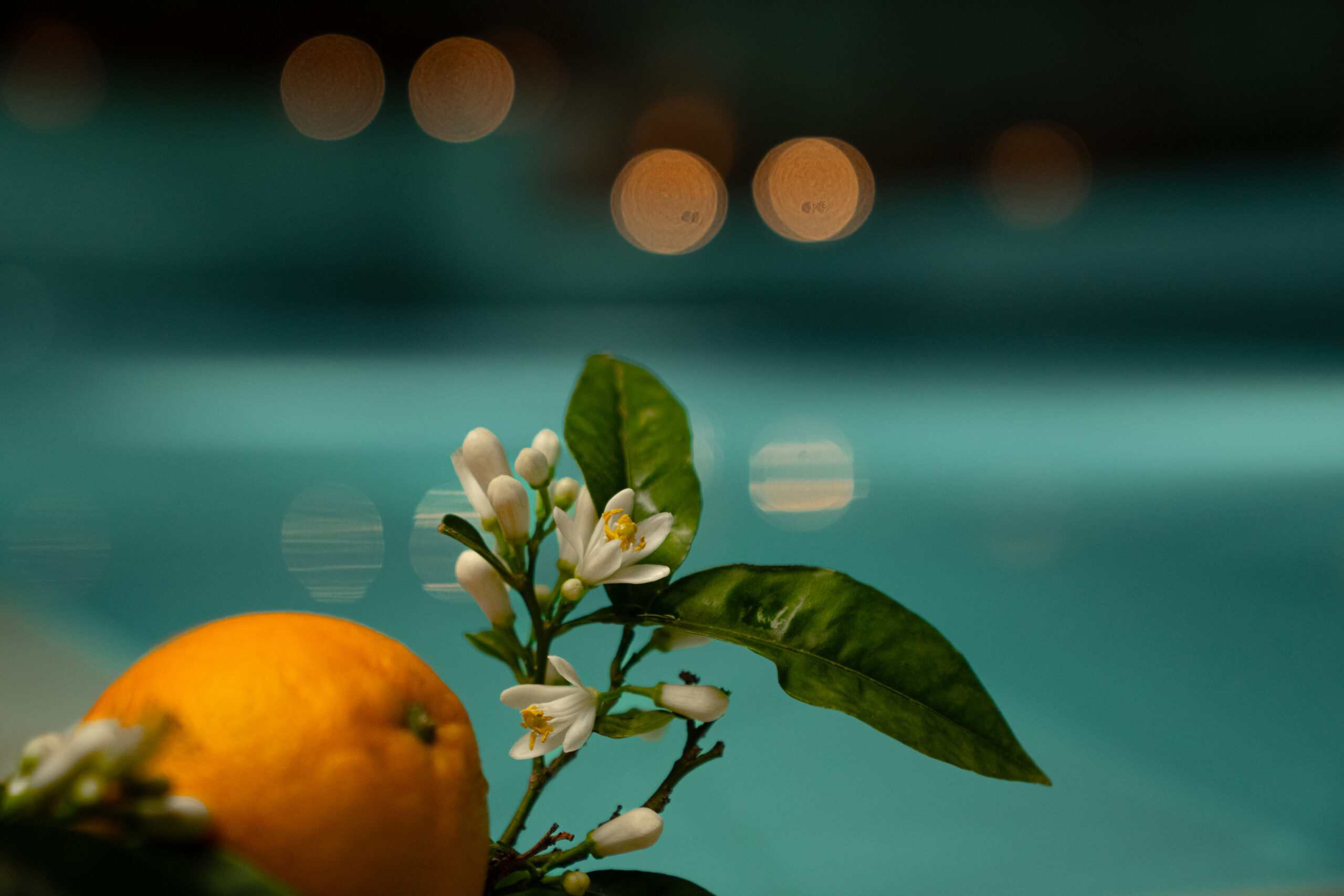


Orange blossom is one of those scents that seems to carry an entire season with it. The flower of the orange tree, small and white with an intensely sweet fragrance, has been prized for centuries in perfumery, skincare, cooking, and ritual. From the orange groves of Seville to the wedding traditions of European royalty, orange blossom appears across cultures in a way that few flowers can claim. This article brings together everything worth knowing about the flower, the essential oil it produces, and the water that comes with it.
What is orange blossom?
Orange blossom is the flower of the orange tree. What is the name of the orange tree flower in botanical terms? The flower comes from Citrus sinensis, the common sweet orange, and from Citrus aurantium, the bitter orange, with the latter being the variety most commonly used in perfumery and essential oil production.
When steam-distilled, orange blossom produces one of the most prized essential oils in the world: neroli. The name is said to come from Anne Marie Orsini, Princess of Nerola in seventeenth-century Italy, who was known for using the oil to scent her bath water, her gloves, and her clothing. The association stuck, and neroli has carried that name ever since.
The production of neroli oil is labour-intensive in a way that explains its cost. It takes roughly 1,000 pounds of orange blossoms to produce a single pound of essential oil. The flowers must be hand-picked, ideally in the early morning before the heat of the day diminishes their fragrance, and distilled quickly after harvesting. That combination of delicacy, abundance required, and time-sensitivity is what places neroli among the more expensive raw materials in perfumery.
Orange blossom water: what it is and how it is used
Orange blossom water, also called orange flower water, is a byproduct of the same steam-distillation process used to produce neroli oil. As the steam passes through the blossoms and then condenses, it carries with it the lighter, more water-soluble aromatic compounds of the flower. The result is a lightly scented liquid that retains the characteristic fragrance of orange blossom without the concentration of the essential oil.
In cooking, orange blossom water has a long history of use across Middle Eastern and Mediterranean cuisines. It appears in baklava, Turkish delight, and other confections where its floral note adds depth without overpowering. It is used in pastries, rice puddings, and drinks across Morocco, Lebanon, and Turkey, often in combination with rose water. A few drops are generally enough: the flavour is subtle but distinctive, and a little goes a long way.
In skincare, orange blossom water is used as a gentle toner. Applied to the face after cleansing, it is considered suitable for sensitive skin and is traditionally associated with a mildly astringent, balancing effect. It is lighter than the essential oil and can be applied directly without dilution, which makes it a practical addition to a skincare routine even for those who find essential oils too concentrated.
Orange blossom in culture
Orange blossom has one of the most consistent symbolic histories of any flower. Across European, Middle Eastern, and Mediterranean traditions, it has long been associated with purity, new beginnings, and fertility, which explains its enduring presence at weddings.
The association with bridal wear was significantly reinforced by Queen Victoria, who in 1840 chose to wear a crown of orange blossoms at her wedding to Prince Albert rather than the jewelled tiara that royal brides had traditionally worn. The choice was widely noted and imitated, and the practice of wearing or carrying orange blossom at weddings spread rapidly through Victorian Britain and beyond. The tradition has continued in various forms through generations of European royalty and remains a recognisable motif in wedding culture today.
In Spain, the connection between orange blossom and celebration has its own particular character. Seville, one of the cities where AIRE has a presence, is famous for its orange trees. The city is lined with bitter orange trees whose blossoms fill the streets with fragrance in spring, and the timing of that bloom coincides with two of the city’s most important annual celebrations: the Feria de Abril and Corpus Christi. The scent of orange blossom has become inseparable from the atmosphere of Seville in springtime, and it appears throughout the city’s food, drink, and craft traditions.
In perfumery, orange blossom and neroli have appeared in some of the most enduring fragrances in history. Eau de Cologne, one of the oldest perfume formats still produced today, was originally built on a base of citrus and orange blossom. The scent has remained central to the traditions of both classic and contemporary perfumery.
Properties of orange blossom for skin and hair
Orange blossom oil has a number of properties that have made it a valued ingredient in cosmetic formulations for centuries.
Antibacterial and antiseptic properties
Orange blossom oil contains compounds with mild antibacterial and antiseptic properties, which is one reason it has been used traditionally in skincare products aimed at oily or blemish-prone skin. These properties make it a useful addition to formulations where a gentle cleansing or purifying effect is desired.
Skin toning and pore appearance
Used as a toner, diluted orange blossom oil or orange blossom water is traditionally associated with helping to refine the appearance of pores and balance the skin’s surface. It is particularly associated with oily and combination skin types.
Stretch marks
Orange blossom oil has a long tradition of use in formulations aimed at reducing the visibility of stretch marks, particularly during and after pregnancy. It is typically used in a diluted form, blended with a carrier oil, and applied with regular massage. The results are gradual and variable, as with most cosmetic approaches to this kind of skin change.
Hair care
For oily hair types, orange blossom oil is sometimes used as a conditioning treatment or added in small quantities to hair products. Its mild astringent properties are associated with helping to balance sebum production at the scalp, though as with any essential oil, it should be used diluted rather than applied directly to the scalp in concentrated form.
Benefits of orange blossom for relaxation and mood
Orange blossom and neroli have a long-established reputation as calming scents. In traditional aromatherapy, the fragrance is associated with easing feelings of anxiety, nervous tension, and stress, and it appears frequently in formulations and blends aimed at relaxation and emotional balance.
Many people find the scent of orange blossom particularly effective as part of an evening or bedtime routine. A few drops of diluted neroli oil added to a warm bath, or orange blossom water misted onto a pillow, are traditional uses that reflect the flower’s long association with calm and sleep support. Whether through the fragrance itself or the ritual of the routine, the combination of warmth, scent, and deliberate slowdown is one that many people find genuinely restorative.
The scent is also widely used in massage. Its floral, slightly sweet character tends to feel neither overpowering nor medicinal, which makes it a natural choice for relaxation-focused treatments where the aim is to support a sense of ease rather than to stimulate.
Orange blossom at AIRE
Orange blossom has a specific place within the AIRE Experience. The AIRE Home Collection includes an orange blossom candle, designed to bring some of the sensory atmosphere of the spa into an everyday home setting. The scent is chosen for its calming and uplifting quality, and it translates well to the domestic context of an evening wind-down or a slow weekend morning.
Within the AIRE spa experience itself, orange blossom appears in the Escape Together Experience, a couples package that includes a 45-minute massage with warm orange blossom-scented compresses. The combination of heat, scent, and touch makes this one of the more complete sensory treatments in the AIRE offering, and it reflects the tradition of using orange blossom as a scent associated with intimacy, calm, and shared time.
For those interested in exploring the orange blossom experience at AIRE, whether through a treatment, a gift card, or the Home Collection, the most current details on availability and booking can be found directly with your nearest AIRE Location.

Frequently asked questions about orange blossom
What is orange blossom?
Orange blossom is the flower of the orange tree. It is small, white, and intensely fragrant, and has been used for centuries in perfumery, skincare, and cooking. When steam-distilled, the flowers produce an essential oil known as neroli, as well as a lightly scented byproduct called orange blossom water or orange flower water.
What is the name of the orange tree flower?
The flower of the orange tree is called orange blossom. In botanical terms, it comes from the genus Citrus, most commonly Citrus sinensis (sweet orange) or Citrus aurantium (bitter orange). The essential oil produced from the flowers is called neroli, a name that derives from seventeenth-century Italy.
What is orange blossom water used for?
Orange blossom water has two main uses. In cooking, it is used as a flavouring in Middle Eastern and Mediterranean cuisine, appearing in desserts such as baklava and Turkish delight, as well as in pastries, rice puddings, and drinks. In skincare, it is used as a gentle toner suitable for sensitive skin, applied directly to the face after cleansing.
Is orange blossom the same as neroli?
They come from the same flower but are not exactly the same thing. Neroli is the essential oil produced by steam-distilling orange blossom flowers. It is highly concentrated and used primarily in perfumery and aromatherapy. Orange blossom water is the lighter, water-based byproduct of the same distillation process, used in cooking and as a skincare toner. Both share the characteristic fragrance of the orange blossom flower.
What are the benefits of orange blossom for skin?
Orange blossom oil is traditionally associated with several cosmetic benefits: mild antibacterial and antiseptic properties that make it useful for oily or blemish-prone skin, a toning effect that is associated with refining the appearance of pores, and use in formulations aimed at reducing the visibility of stretch marks. It is also used in hair care products for oily hair types. In all cases, the essential oil should be diluted before use on the skin.